
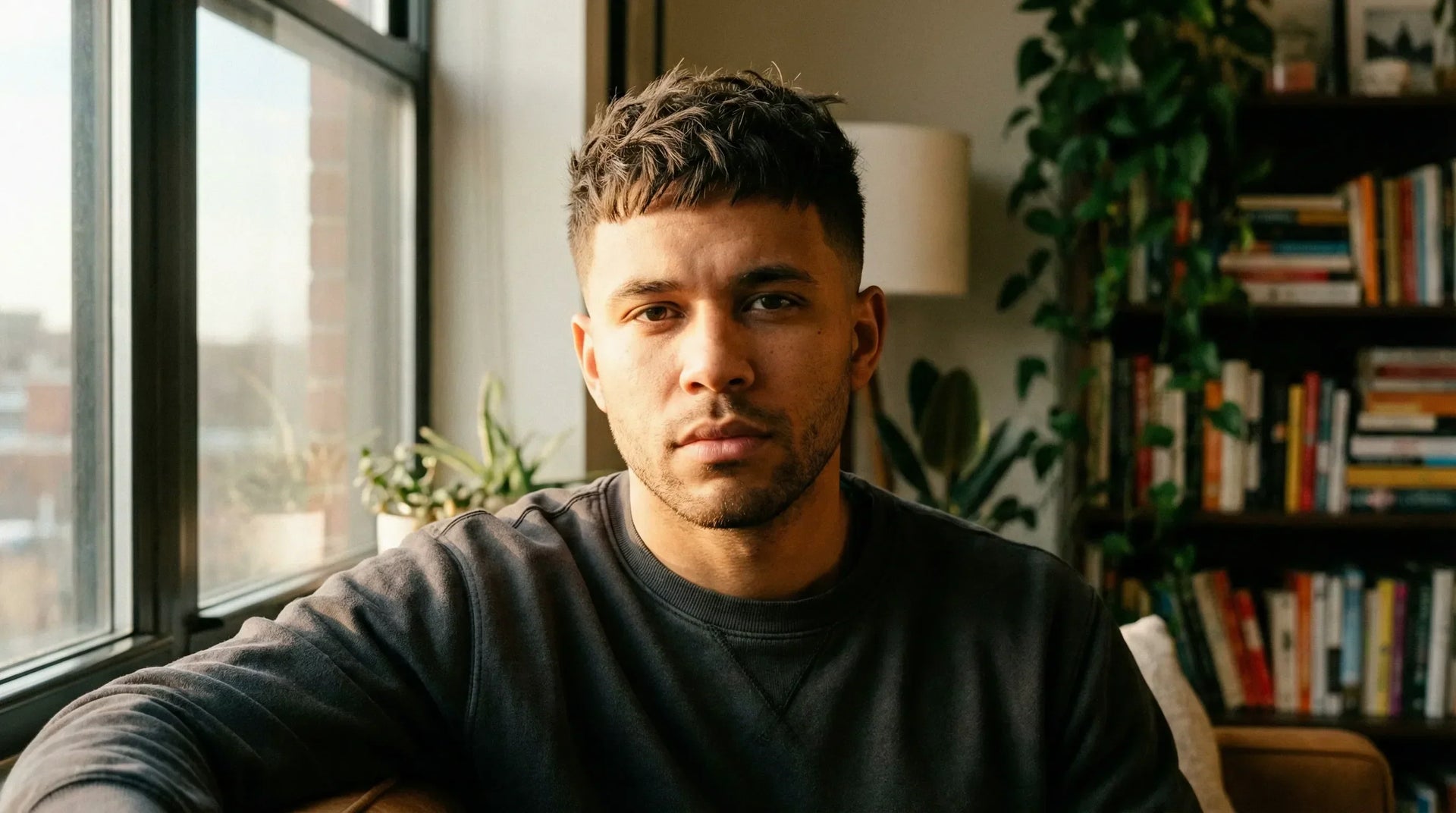
Most thick hair advice fails because it treats one problem like it’s a different one. Articles tell you to use stronger hold, shorter cuts, and “thinning shears” without ever asking what kind of thick hair you actually have. There are two kinds, they need opposite approaches, and that’s the reason your styling never quite clicks. This guide fixes that.
You’ll find 18 hairstyles below, organized by length, with the cut spec to show your barber, the styling steps in order, and the products that genuinely help (and the ones that don’t). Plus the one thing about thick hair that almost no other article gets right.
First, figure out which kind of thick hair you have
“Thick hair” means two completely different things, and almost every blog conflates them.

Density vs. diameter: which kind do you have?
High density means you have a lot of strands. Hair fills the scalp, ponytails are fat, your barber tells you it takes longer to cut. Each strand might be normal width, but there are just more of them.
Coarse diameter means each individual strand is wide. Lay one on a piece of paper and you can see it clearly, almost like a thread. The strand is strong, holds shape well, and frizzes in humidity because the cuticle has more surface area to lift.
You can have one without the other. High-density hair with fine strands looks full but goes flat under heavy product. Coarse hair with low density feels dry and “rough” but doesn’t actually have that much volume. Most guys have one of these, not both.
High density needs bulk removal. The cut does the heavy lifting. Layers, internal weight removal, and length distribution let the hair sit instead of mushroom. Heavy product makes it worse, not better.
Coarse diameter needs moisture and weight. The strand has to be softened so it bends and behaves. Lightweight products slide off and leave the hair stiff. You want a pre-styler with real moisture (oil or hydrating cream) and a finisher that can hold a wide strand in place.
Two quick at-home tests:
- Density check: Pull all your hair into a fist (or a ponytail if it’s long enough) and look at the base. If you can barely close your hand around it, that’s high density. If your fingers wrap easily, that’s lower.
- Diameter check: Pluck one strand and lay it on a sheet of white paper. If you can see it from across the room, you’ve got coarse strands. If you have to look closely, your strands are medium or fine even though you have a lot of them.
Note your answer. It changes which products in the next sections will actually work for you, and which ones to skip.
The one rule that changes everything: cut beats product
Thick hair is the only hair type where the cut matters more than the product. The wrong cut on thick hair cannot be saved by product. The right cut on thick hair barely needs product at all.
This is why guys with thick hair spend $200 on styling stuff and still look bulky by Wednesday. They’re trying to fix a structural problem with a topical solution. The structure is the haircut: how it’s layered, where bulk is removed, how length is distributed across the head. A skilled barber can take the same head of hair and make it look completely different with internal layering and weight removal that you’d never see in a photo.
The lesson: spend the energy on finding a barber who knows how to cut thick hair before you spend it on products. If your current barber’s solution is “go shorter,” they’re solving the wrong problem. A good thick-hair cut leaves length but redistributes the bulk so the style sits where you want it.
Once the cut is right, product is the final 20%. We’ll cover that in the styling system section after the gallery.
Short hairstyles for thick hair (under 2 inches on top)
Short cuts are the easiest path for thick hair because there’s less mass to control. They lean toward the high-density approach (let the cut do the work, minimal product). All of these work for both kinds of thick hair, but they’re especially good if your problem is sheer bulk.

1. Buzz Cut
The cleanest answer to thick hair. Hair is clipped to a uniform length, usually a #1 to #4 guard, with the sides faded or kept the same length. The thickness becomes texture on the scalp instead of mass on top. Strong jawlines and well-shaped heads benefit most.
How to style: Towel dry. Run a small amount of Matte Cream Clay through with your fingertips for a slight matte finish. That’s it.
Best for: Both kinds of thick hair, any face shape that’s not extremely round.

2. Crew Cut
Slightly longer than a buzz, with a bit more length on top that tapers shorter toward the back. Sides are short or faded. The top has just enough height to read as styled rather than shaved. A great low-maintenance option that still looks intentional.
How to style: Towel dry. Apply a small amount of Matte Cream Clay from root to tip, working from the back of the head forward. Push the front slightly up and to the side with your fingers.
Best for: Both kinds of thick hair. Particularly good for high-density hair where longer styles get bulky.

3. Caesar Cut with Texture
Short all over with a defined fringe pushed forward toward the forehead. The texture variation comes from how the barber cuts the top: choppy and uneven rather than blunt. Looks best with a slight taper or fade on the sides.
How to style: Apply Matte Cream Clay to dry hair, work it through with fingers, push the fringe forward and slightly to one side. The texture should look broken-up, not smooth.
Best for: Coarse strands especially. The natural strand texture sells the look.

4. French Crop
A close European cousin of the Caesar with a heavier, blunter fringe that sits flat against the forehead. Sides are usually faded for contrast. The fringe can be straight across or slightly angled. Very forgiving for guys whose hairlines have started to recede, since it covers the front naturally.
How to style: Towel dry, work a pea-sized amount of Wax Fiber through the top, push the fringe forward and press it slightly down. The fringe should look heavy and intentional, not floaty.
Best for: Both kinds of thick hair. Strong choice for round and oval faces.

5. Textured Crop
The most popular short cut in barbershops right now. Top is kept slightly longer than a French crop (1.5 to 2 inches), heavily textured, with a short or faded back and sides. The texture is the whole point: choppy, broken-up, with deliberate movement. Thick hair is perfect for this because the natural density sells the volume without extra effort.
How to style: On damp hair, work in a small amount of Wax Fiber. Blow dry forward and slightly to the side, scrunching the top with your fingers to add lift. Finish with a touch of Matte Cream Clay on dry hair to separate the strands and hold the texture.
Best for: Both kinds of thick hair. One of the most universally flattering cuts on this list. For a deeper look at this style, see our full textured crop haircut guide.

6. Burst Fade with Crop
A crop on top paired with a burst fade that arcs around the ear instead of running straight down the side. The contrast between the dense top and the faded sides makes thick hair look intentional rather than overgrown. The burst is more modern than a standard fade and frames the head shape.
How to style: Same as the textured crop. Pre-styler on damp hair, blow dry forward, small finishing product to define the texture.
Best for: Both kinds of thick hair. Works especially well on round and square faces because the burst fade softens the sides.
Medium-length hairstyles for thick hair (2 to 4 inches on top)
This is where thick hair starts needing the styling system instead of just a good cut. The longer the top, the more the pre-styler matters. For medium-length cuts on thick hair, the pre-styler is doing 60% of the work.

7. Mid-Length Messy
2 to 3 inches on top, lightly textured by the barber, sides kept medium-short or faded. The cut is built to look casually disheveled but intentional. Works best when the barber removes internal bulk during cutting so the top doesn’t sit like a helmet.
How to style: On damp hair, work Hydrating Hair Oil from root to tip (this softens the strand and prevents the puffy look). Blow dry with fingers, pushing hair in different directions to break up any natural lay. Finish with a small amount of Matte Cream Clay through dry hair, scrunching to separate the pieces.
Best for: Coarse strands especially. Hair Oil is non-negotiable here for coarse hair.

8. Textured Quiff
The top is styled up and back with visible texture and movement. The sides are faded or tapered. A quiff on thick hair has a presence that no other hair type can match because the natural density gives the height authority. The trick is texturing the top so it doesn’t read as a solid wall.
How to style: On damp hair, work in Hydrating Pomade from root to tip. Blow dry up and back with a round brush or fingers, over-exaggerating the height (this matters: blow dry crazier than the final look). Finish with Heavy Hold Clay through the top, shaping with your fingers and locking the height in.
Best for: Both kinds of thick hair, oval and square faces. The quiff genuinely needs the full pre+post system.

9. Modern Side Part
A defined part on one side, with the longer top swept across. Modernized by faded or tapered sides instead of the classic short-but-not-faded look. Thick hair makes the sweep look heavy and substantial, which is the entire appeal.
How to style: On damp hair, work in Hydrating Pomade. Comb the part where you want it (your hair has a natural one, find it). Blow dry across, following the part, with a comb or round brush. No finisher needed for a softer look, or add a touch of Wax Fiber on dry hair if you want more hold and a bit of texture.
Best for: Coarse strands especially. The pomade weight controls the wide strands and gives the part a clean line.

10. Brush Up
The top is brushed straight up rather than back or to the side. Sides are usually faded. Thick hair is ideal for a brush up because there’s enough mass to support the vertical lift without looking sparse. A bigger commitment than a quiff and reads more modern.
How to style: On damp hair, Hydrating Pomade root to tip. Blow dry straight up using fingers or a round brush, lifting from the roots. Once 100% dry, work Heavy Hold Clay through and shape the front with your fingers.
Best for: Both kinds of thick hair, especially high density where the upward lift shows off the volume.

11. Faux Hawk
The hair is styled up into a center ridge from front to back, with shorter sides for contrast. A faux hawk on thick hair has more presence than on any other type because the ridge has real density behind it. Works on most face shapes if the sides are blended properly.
How to style: Same system as the brush up. Pre-styler on damp hair, blow dry upward and toward the center, finish with Heavy Hold Clay shaped from the sides toward the center ridge.
Best for: Both kinds of thick hair. Confidence helps.

12. Pompadour
The classic. Long on top, swept up and back into a defined wave at the front. Sides faded or tapered short. A pompadour on thick hair is what every styling product company wishes their model had, because thick hair is what makes a pompadour actually pompadour-shaped instead of a flat sweep.
How to style: This one earns its full system. Damp hair, Hydrating Hair Oil at the roots and through the strand, then Hydrating Pomade on top of that for hold. Blow dry up and back with a round brush, building the front wave as you go. Once 100% dry, work Heavy Hold Clay through the top, shaping the wave with your fingers and locking the height.
Best for: Coarse strands more than high density. The pomade plus oil combo softens the strand enough to bend into the wave shape.

13. Curtain Fringe
Length on top swept from a center or off-center part to either side, framing the forehead. Sides medium or short. Thick hair gives the curtain genuine weight and movement, which is the whole appeal. Works well for round and long faces because the curtain frames the forehead and softens the head shape.
How to style: Damp hair, Hydrating Hair Oil through the strand. Blow dry forward and to the sides, splitting the fringe with fingers or a comb. Finish with a small amount of Wax Fiber on dry hair to keep the curtain moving without locking it.
Best for: Both kinds of thick hair, especially coarse strands where the oil tames the natural frizz.
Long hairstyles for thick hair (4+ inches on top)
Long thick hair is high commitment but high reward. The styling system becomes mandatory, not optional. Skip the pre-styler at this length and your hair will be unmanageable by midday.

14. Bro Flow
Hair grown out to ear length or longer, swept back from the face with natural movement. The sides are usually grown out to match. The cut is mostly about long layers that let the hair fall naturally without bulking at any one point. Think Keanu Reeves, late-stage Brad Pitt, or any mid-length Hollywood lead from the past few years.
How to style: On damp hair, Hydrating Hair Oil from root to tip. Blow dry back and away from the face, using a round brush to build movement. Once dry, work a tiny amount of Wax Fiber through with fingers to define the pieces without making them stiff.
Best for: Coarse strands. The oil controls frizz over the longer length.

15. Mid-Length Layers
Length to about the jaw or slightly past, with internal layers cut to remove bulk and create movement. This is the cut to ask for if your hair is heavy and you want to keep length. The layering is invisible from the outside but the difference in how the hair sits is dramatic. Almost any mid-length style benefits from layering on thick hair.
How to style: Damp hair, Hydrating Hair Oil root to tip, then Hydrating Pomade for hold. Blow dry in the direction you want the hair to fall, scrunching gently as you go to encourage movement. Finish with Wax Fiber through the lengths.
Best for: Both kinds of thick hair, especially high density where layers prevent the helmet effect.

16. Long Quiff
A quiff with significantly more length on top (4 inches or more), swept up and back into a tall, defined wave. Less polished and more dramatic than the medium-length version. Thick hair is one of the only types that can pull off a long quiff convincingly because lesser hair types don’t have the structural strength to hold the height.
How to style: The full system, no shortcuts. Damp hair, Hydrating Hair Oil, then Hydrating Pomade. Blow dry up and back with a round brush, over-exaggerating the height (it should look almost cartoonishly tall before you finish). Once 100% dry, work Heavy Hold Clay through the top from root to tip, shape the wave, then cold-blast with the dryer to lock the cuticle.
Best for: Coarse strands. High commitment but the result is unmistakable.

17. Modern Mullet
Short on the sides and front, longer in the back. Updated from the 80s version with more nuance: textured on top, blended into the longer back rather than a hard line, often with curtain bangs or a slight fringe. Thick hair sells the modern mullet because the back has real density and movement instead of looking stringy.
How to style: On damp hair, Hydrating Hair Oil through the back length, Hydrating Pomade on top. Blow dry the top forward and the back down, encouraging the natural fall. Finish with Wax Fiber on the top for definition.
Best for: Both kinds of thick hair, particularly if you’ve got natural wave or curl in the back.

18. Messy Brushback
Length on top brushed loosely back from the front, with deliberate looseness instead of polished slickness. Sides medium-short or faded. The messy brushback splits the difference between a clean slicked-back look and a casual bro flow: it has the swept-back direction of a slick back but the natural movement and texture of a tousled style.
How to style: On damp hair, work Hydrating Hair Oil through the strand to soften the texture, then a small amount of Hydrating Pomade for workable hold. Blow dry back and slightly to the side using your fingers, encouraging natural movement. Once dry, work a small amount of Wax Fiber through the top with your fingers to break up the strands. Skip the comb on this one, fingers are the whole point.
Best for: Coarse strands especially. The natural strand structure is what gives the messy brushback its lived-in look.
The styling system thick hair actually needs

The hairstyles above hint at the system, but it’s worth spelling out clearly: thick hair, especially anything past 2 inches, needs a pre-styler and a finisher working together. One product won’t do it.
The pre-styler softens the strand and locks in the shape while the hair dries. This is the part most guys skip and the part that fails their styling. Thick hair has to be shaped while it’s drying, not after. Once thick hair dries, it locks. If you wait until your hair is dry to apply product, you’re trying to override the shape your hair already chose for itself, and it will fight you all day.
For coarse strands, the pre-styler needs moisture. Hydrating Hair Oil is the right answer because oil softens the cuticle and tames the strand from the inside out. Hydrating Pomade goes on top of it (yes, both) for the actual hold during the blow dry. This is the founder’s personal combo: Joe has coarse thick hair and built BLUMAAN around solving exactly this problem.
The finisher locks the shape and adds texture or hold. For most thick hair styles, that’s Matte Cream Clay (versatile, scales with how much you use, matte finish) or Heavy Hold Clay for the styles that need structure (pompadour, quiff, brush up, faux hawk). Heavy Hold Clay is specifically built for thick hair; on fine or thin hair it’s overkill.
The blow dry direction matters. Thick hair has a natural lay that wants to fall a certain way. To break it, blow dry against the natural lay first (if your hair falls forward, blow it backward; if it falls right, blow it left). Once the strand is forced out of its memory, then dry it in the direction you actually want.
And dry to 100%. Most guys stop at 80% because their hair “looks dry enough.” It isn’t. Hair that’s still slightly damp will fall back to its natural lay over the next two hours as it finishes drying. Dry it all the way, and the style stays put.
For more on the styling system, see our full guide on how to style men’s hair at home.
Products to avoid with thick hair
Most articles about thick hair recommend everything in the catalog. We don’t, because most of the catalog is wrong for you.
Skip lightweight pre-stylers like volume mousses, sea salt sprays, and volume creams. These are built for fine and thin hair to add lift the hair doesn’t have on its own. Thick hair already has volume; what it needs is control. Texturizing Sea Salt Spray and Volume Cream are excellent products, just not for you.
Skip heavy waxes that don’t move. Old-school waxes were built before anyone thought about how thick hair behaves. They build up on the strand, weigh it down, and create the exact greasy heavy look you’re trying to avoid.
Skip “all-in-one” styling products that promise everything. The whole point of the system above is that one product cannot do both jobs. Thick hair has too much going on for a single-product approach.
For a full breakdown of which finisher to use, see our wax vs clay vs pomade guide.
Frequently asked questions
What’s the best haircut for men with thick hair?
The best haircut for thick hair is one cut by a barber who knows how to remove internal bulk while keeping length. If you want a starting point, the textured crop is the most universally flattering option for thick hair across face shapes and ages, requires moderate styling effort, and pairs naturally with a fade or taper that controls the sides. Bring two or three reference photos to your barber and ask specifically about thinning the interior, not just shortening the length.
What’s the difference between thick hair and coarse hair?
Thick hair refers to density: how many strands you have per square inch of scalp. Coarse hair refers to diameter: how wide each individual strand is. They’re independent traits and you can have one without the other. Knowing which you have changes which products work and which don’t. High density needs bulk removed by the cut, while coarse needs moisture from the product.
How do I make my thick hair less puffy?
Puffy thick hair is almost always a moisture problem, a cut problem, or both. Add moisture through a hydrating pre-styler (oil for coarse strands, hydrating cream for less coarse), blow dry the hair against its natural lay first to break the memory, then set the direction you actually want. Pre-styler first, finisher second.
What products should men with thick hair avoid?
Avoid lightweight volumizers (mousses, salt sprays, volume creams) because thick hair doesn’t need added lift, it needs control. Avoid heavy old-school waxes that build up and weigh hair down. Avoid “all-in-one” products that promise to be pre-styler, finisher, and hold in one tube. Stick to a pre-styler with real moisture, then a finisher matched to the style you want.
Should men with thick hair use thinning shears?
Yes, but only in the hands of a skilled barber, and only in specific places. Thinning shears remove internal bulk without affecting the visible length. Used well, they’re the secret weapon that makes thick hair sit naturally. Used badly, they create choppy patches. Don’t use them at home.
How often should men with thick hair get a haircut?
Every 4 to 6 weeks for short and medium styles. Long thick styles (bro flow, mid-length layers, messy brushback) can stretch to 6 to 8 weeks. Any style with a fade needs a touch-up every 2 to 3 weeks because the fade line softens fast.
Where to start
If you’re not sure which style fits your hair best, take our 2-minute product finder quiz and we’ll match you to the right pre-styler and finisher for your specific hair type. The thick hair bundle (Hydrating Hair Oil + Hydrating Pomade + Heavy Hold Clay) is what most coarse-thick-hair guys land on, and it ships free on U.S. orders over $60.