
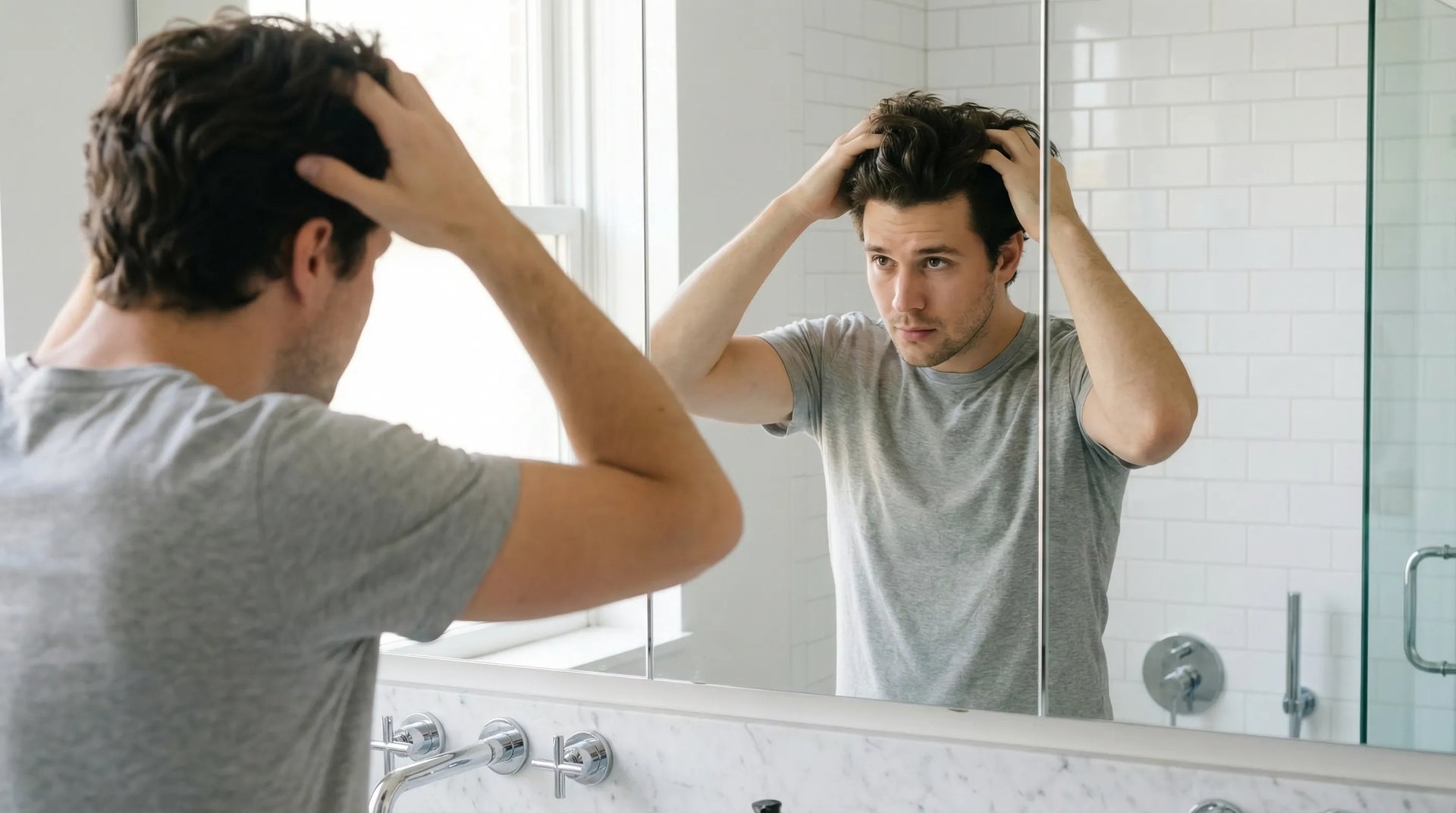
Most guys walk out of the barbershop looking great and then never come close to replicating it at home. The cut is the same. The tools are available. What's missing is a system: a repeatable sequence of steps that takes hair from damp towel to styled and holding all day. This guide covers that system, step by step, for every hair type.
It Starts With Damp Hair
Not dripping wet. Not bone dry. Damp.
Towel-dry your hair by pressing the towel against your head and squeezing gently. Don't rub it back and forth. Rubbing creates friction that roughens the hair cuticle, adds frizz, and can cause breakage over time.
Why damp? Two reasons. First, product distributes more evenly through damp hair than dry hair. The moisture helps it spread from root to tip instead of sitting on the surface. Second, damp hair is shapeable. A blow dryer can push damp hair into a position and train it to hold that shape. Dry hair has already settled into its natural fall, and product alone is fighting against that.
If you skip this step and try to style fully dry hair with product only, you're starting from behind. The blow dryer and pre-styler need moisture to work with.
The Pre-Styler + Finisher System
Here's the concept most guys miss: styling isn't one product. It's two stages with two to three products working together.
Stage 1: Pre-styling (damp hair, blow dry in). This is where 50 to 65% of the work happens. A pre-styler builds the foundation. For fine hair, it creates volume and body. For thick hair, it calms the cuticle and makes hair cooperative. You apply it to damp hair and blow dry it in.
Think of pre-styling like a house foundation. A beautiful house on a rocky, unstable foundation might look great but won't last. A solid foundation keeps it standing. Pre-styling is the foundation. Everything after is the finishing touch.
Some hair types need a single pre-styler. Others benefit from layering two. Thick hair, for example, often needs moisture (like a hair oil to calm the cuticle) combined with a structuring product (like a pomade for shape), both blown in before the finisher. The pre-styling stage adapts to what your hair needs.
Stage 2: Finishing (dry hair). The finisher locks in the shape you built during the blow dry. It adds hold, texture, or separation depending on the product. This goes on after hair is fully dry.
Most guys only use a finisher. They skip the pre-styler, apply one product to dry hair, and wonder why it doesn't hold past lunch. That's like building a house without a foundation and expecting it to survive a storm.
Quick reference by hair type:
- Thin/fine hair: Volume Cream (pre-styler) + Matte Cream Clay or Wax Fiber (post-styler)
- Thick hair: Hydrating Hair Oil + Hydrating Pomade (pre-styler) + Heavy Hold Clay or Matte Cream Clay (post-styler)
- Wavy/curly: Texturizing Sea Salt Spray or Hydrating Hair Oil (pre-styler) + Matte Cream Clay or Hydrating Pomade (post-styler, lighter amount)
- Straight/normal: Texturizing Sea Salt Spray or Volume Cream (pre-styler) + Wax Fiber or Matte Cream Clay (post-styler)

How to Blow Dry Men's Hair
The blow dryer is the most important styling tool you own. More important than any product. It shapes hair, builds volume, and sets the foundation that product locks in.
Use the nozzle attachment. The flat nozzle concentrates airflow so you can direct heat precisely. Without it, air scatters and you lose control of where the hair goes. (Exception: if you have curly hair, ditch the nozzle and use a diffuser instead. A nozzle blows curls around and fights the curl pattern. A diffuser dries without disrupting.)
Medium heat, high airflow. You don't need maximum heat. Medium heat with strong airflow does the job without frying your hair.
Over-exaggerate the style. This is the technique that separates a barber-quality result from a mediocre one. When blow drying, push the volume and shape further than you actually want it. If you want a textured quiff, blow it up until it looks almost ridiculous. If you want a brushback, blow it way further back than the final result needs to be.
Why? Because when you apply the finishing product, it tames the hair back down. If you blow dry to exactly where you want the hair to land, the finisher will push it past that point and you end up flat. Over-build during the blow dry so the finisher brings it back to the perfect middle ground.
Dry to 100%. Not 80%. Not "close enough." This is the mistake that kills most home styling attempts. Guys blow dry until hair feels "mostly" dry and stop. The hairstyle looks good for about 30 minutes, then falls back to the hair's natural shape.
Think of it like ironing a shirt. Pull it from the washer still damp, iron it, lay it flat. As the remaining moisture evaporates, the wrinkles come right back. Fully dry it in the dryer first, then iron. The crease holds until the shirt gets wet again. Same principle with hair. Dry to 80% and the style collapses as the remaining moisture evaporates. Dry to 100% and the shape is locked in.
How to know you're at 100%: run your fingers through different sections, especially at the roots near the crown. If anything feels cool or damp, keep going.
Cool shot to finish. After the heat drying is done, blast your hair with cold air for 10 to 15 seconds. Cold air seals the cuticle and sets the shape. Most blow dryers have a cool shot button near the trigger.

What If You Don't Use a Blow Dryer?
Not everyone wants to blow dry, and that's fine. You can still style without one, but the options are narrower and the hold won't last as long.
For air-dry styling, apply Texturizing Sea Salt Spray to damp hair and scrunch for natural texture and wave. Let it fully air dry (this can take an hour or more depending on length and thickness). Once dry, apply a small amount of Matte Cream Clay for shape and hold. This works best for messy, casual, low-effort styles. Structured styles like quiffs or pompadours need a blow dryer.

How to Apply Product the Right Way
Amount
Less than you think. Start with a pea-sized amount for short hair, dime-sized for medium length. You can always add more. Too much product weighs hair down, makes it look greasy, and is nearly impossible to fix without washing and starting over.
Emulsify First
Scoop the product and work it between both palms until it fully breaks down. If you can still see product on your hands, it's not ready. This step matters because unemulsified product goes on in clumps. You'll end up with concentrated patches of product and bare spots with no hold.
Back to Front
Start applying at the back of your head and sides. Work forward toward the top and front last. This is counterintuitive because the top and front are what you see in the mirror and feel most tempted to hit first. But the front is where too much product causes the most damage: it weighs down the hairline, kills volume at the fringe, and makes hair look heavy.
By starting at the back, most of the product deposits where it matters least. By the time you reach the front, there's just enough left on your hands for subtle hold without heaviness.
Root-to-Tip Saturation
Get product all the way down to the roots, not just the surface. If you only get product on top, the hair underneath has no support. You've added weight to the outer layer while the base holds nothing. Hair falls flat from the inside out.
Method: after emulsifying, run your fingers through the hair and work down to the scalp. Don't worry about how it looks during application. Get full coverage first, then refine with your fingertips.
Fingers vs. Comb
Use fingers for textured, natural-looking styles. Fingers separate and define without over-smoothing. Use a comb for polished styles (side parts, slick backs). A comb distributes product evenly and creates clean lines.
Styling by Hair Type

Thin or Fine Hair
Fine hair needs lightweight products that create body without adding weight. Strong-hold products seem like the answer ("I need hold to keep it up"), but they're heavy and will flatten fine hair even more. Volume and body come from lightweight pre-styling, not from heavier product.
The routine: Apply Volume Cream to damp hair, focusing on the roots. Blow dry upward and forward, over-exaggerating the lift. Get it 100% dry. Then finish with Matte Cream Clay (light amount) for texture, or Wax Fiber for a bit more hold and fullness. For instant root lift on the go, Clay Texture Powder tapped at the roots adds volume without any visible product. First clay-based texture powder on the market, only five ingredients.
Using Volume Cream and Matte Cream Clay together? That's the Hair Volume & Thickening System bundle ($51.30, saves 10%).
Avoid: Hydrating Hair Oil and Hydrating Pomade. Both are too heavy for fine hair and will weigh it down.

Thick Hair
Thick hair's biggest enemy is poof. Without moisture, thick hair resists styling, puffs out, and fights product. Most guys with thick hair reach for stronger hold and wonder why it still looks like a helmet. The answer isn't stronger hold. It's moisture first.
This goes against most guys' instincts. Moisture sounds like it would make hair greasy or heavy. On thick hair, it does the opposite. It calms the cuticle, makes the hair malleable, and gives it a natural, healthy look instead of a dry, poofy one.
The routine: Start with Hydrating Hair Oil on damp hair to calm the cuticle and add smoothness. Layer Hydrating Pomade over it for structure and moldability. Blow dry into shape. Once fully dry, finish with Heavy Hold Clay for strand separation and all-day hold, or Matte Cream Clay for a lighter, more natural finish on longer styles.
Without the moisture products, the clay makes thick hair too poofy. Without the texture product, the moisture leaves hair too smooth and lifeless. The combination is what makes it work.
Hydrating Hair Oil, Hydrating Pomade, and Wax Fiber together make up the Old Money System bundle ($72.25, saves 15%). For thick hair hairstyle ideas that work with this system, see Best Hairstyles for Men with Thick Hair.

Wavy or Curly Hair
The goal is enhancing your natural pattern, not fighting it.
The routine: On damp hair, apply Texturizing Sea Salt Spray for lightweight grit and wave enhancement, or Hydrating Hair Oil for frizz control and curl smoothing. Scrunch with your hands. If you blow dry, use a diffuser on low heat, scrunching sections upward. If you air dry, just leave it alone and let the product work.
Once dry, a small amount of Hydrating Pomade or Matte Cream Clay defines curls and adds hold without disrupting the pattern. Use less product than you think, and don't comb through it after applying. Combing breaks up the curl formation.

Straight or Normal Hair
The most flexible hair type. Can go in almost any direction depending on which pre-styler and finisher you pair.
For texture and volume: Texturizing Sea Salt Spray (pre-styler) + Matte Cream Clay (post-styler). The spray adds natural grit, the clay adds matte separation.
For fuller, structured styles: Volume Cream (pre-styler) + Wax Fiber (post-styler). The cream builds body, the wax fiber locks in shape with a natural finish.
Blow dry with a nozzle, directing hair in the shape you want. Over-exaggerate the volume. Apply finisher to dry hair, starting from the back.
Five Common Mistakes
Applying product to soaking wet hair. Product slides off wet hair. It can't grip. And whatever does absorb gets diluted by the water. Towel dry to damp first.
Stopping the blow dryer too early. If your hair feels even slightly cool when you run your fingers through it, it's not done. That remaining moisture will undo 30 minutes of work as it evaporates.
Using too much product. More product doesn't mean more hold. It means heavier hair, less volume, and a greasy look. Start small. Add more only if you genuinely need it.
Applying everything to the front first. The front of your hair is the most visible and most sensitive to weight. Hit the back and sides first. The front gets what's left on your hands.
Using one product for everything. A single product can get you 60% of the way there. The system (pre-styler + finisher) is what gets you to 100% and keeps you there all day.
FAQ
How long should styling take?
Once you have the system down, 5 to 10 minutes from towel-dry to finished. The first few times will take longer as you learn the blow dry technique and figure out the right product amounts. After a week of practice, it becomes routine.
Can I style my hair without a blow dryer?
Yes, but the results are different. Air drying with a product like Texturizing Sea Salt Spray gives natural, low-effort texture. But structured styles with volume (quiffs, pompadours, textured crops with lift) need heat to build that shape. If you're serious about styling and don't own a blow dryer, it's the single best tool investment you can make.
How do I make my hairstyle last all day?
Three things: pre-style (build the foundation with a pre-styler on damp hair), blow dry to 100% (not 80%), and finish with the right product on dry hair. Most guys who lose their style by mid-afternoon skipped at least one of these. The cold blast at the end of the blow dry also helps seal the shape.
How much product should I use?
Start with a pea-sized amount for short hair and a dime-sized amount for medium hair. Emulsify it fully between both hands before applying. If the hold isn't enough, add a small amount more. You can always add product. You can't take it out without rewashing.
What's the difference between a pre-styler and a finisher?
A pre-styler goes on damp hair and gets blow dried in. It builds the foundation: volume for fine hair, moisture and control for thick hair, texture for wavy hair. A finisher goes on dry hair after the blow dry. It locks in the shape with hold, texture, or separation. Some products, like Wax Fiber, work as both. Most guys need one of each.
Find Your System
For hairstyle inspiration across every hair type, see Best Men's Hairstyles 2026. Not sure which products are right for your hair? Take the BLUMAAN Hair Quiz to get a personalized recommendation based on your hair type, length, and styling goals. For a full product type breakdown, see our wax vs clay vs pomade guide. Free shipping on U.S. orders over $60.